
How to Read Tire Size: Number On a Tire Explained


How to Read Tire Size and Choose the Right Fit for Your Car?
You’re about to replace your tires, but the numbers on the sidewall look like a secret code. What do they all mean? Understanding tire size is key to ensuring your car handles properly, maintains fuel efficiency, and stays safe on the road. Those letters and numbers indicate everything from width to speed rating, and knowing how to read them can make all the difference. This guide breaks it all down in a simple way, explaining how to read tire size and how to choose the perfect fit for your vehicle. No more guesswork—just the right tires for a smooth ride.
Why Should You Learn About Tire Size?
The tire code is just like an identification, it tells you everything about the tire’s specs, from size to construction. Here’s why it’s important:
l Safety & Handling: The right tire size directly impacts your vehicle’s handling. It helps maintain stability during sharp turns while improving grip in wet or icy conditions. This reduces the risk of accidents and ensures better control on the road.
l Optimal Performance: Properly sized tires enhance your car’s traction, contributing to better acceleration, braking, and cornering. Besides, the right fit can improve fuel efficiency by reducing rolling resistance.
l Legal Compliance: The recommended tire size keeps you in line with legal requirements and avoids insurance hassles. Non-compliant tires can lead to fines and void warranties, and may even affect your insurance coverage in case of an accident.
l Cost Savings: Well-fitted tires enhance fuel efficiency and save you money on both maintenance and gas in the long run.
How Do You Read Tire Size?
Now that you know tire size is important for your vehicle’s safety and performance, it is time to learn how to check tire size. It’s easier than you might think. Let’s break it down and make it simple.
Tire Type
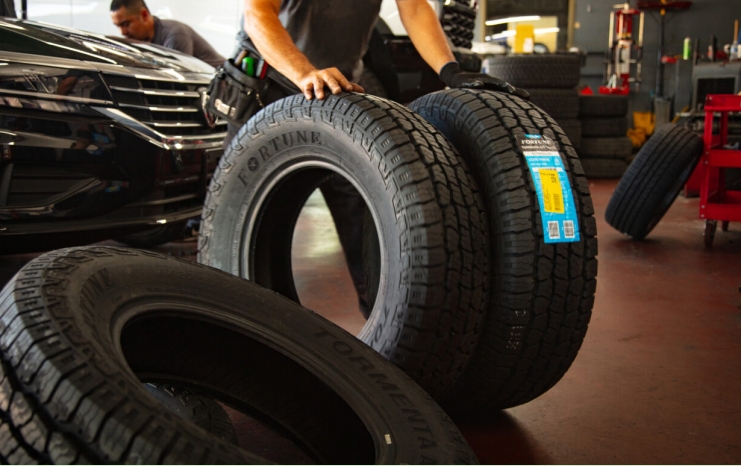
When learning how to read tire specs, the first step is understanding the first letter. The prefix in the tire code "P", "LT", "T", or "ST" indicates the tire type and its intended use. Let's take it in detail:
l P (Passenger): Standard for everyday cars, like sedans, coupes, minivans, and light-duty vehicles (e.g., P215/65R15).
l LT (Light Truck): Designed for trucks, SUVs, or trailers carrying heavier loads or tow.
l T (Temporary): It means temporary spare tires (e.g., T145/80R18). They are used as a short-term solution until a proper tire replacement is made.
l ST (Special Trailer): Exclusively for trailers, not vehicles.
Note: European tires (ETRTO standards) often omit the prefix (e.g., 205/55R16).
Width
The 3-digit number immediately following the tire type (e.g., “215” in P215/65R15) represents the tire’s section width in millimeters (mm). This is the distance between the outer and inner sidewalls at their widest point, measured when mounted on a specified width wheel. The width affects handling, performance, and how the tire fits on your vehicle. Wider tires offer better grip, but narrow tires can improve fuel efficiency by reducing rolling resistance.
Aspect Ratio
The 2-digit number after the slash (e.g., “65” in P215/65R15) is the aspect ratio, expressing the sidewall height as a percentage of the section width. If you want to calculate by yourself, you can follow the following formula:
Sidewall height = (Width × Aspect Ratio) / 100
Example: 215 mm × 0.65 = 139.75 mm sidewall height. This means the tire’s height is 65% of its width, or approximately 139.75 mm (65% of 215mm).
Besides, you should know that a lower aspect ratio (e.g., 50 or 45) indicates a shorter, stiffer sidewall, which is typically found in performance tires. A higher aspect ratio (e.g., 75 or 80) indicates a taller, more flexible sidewall, which provides a smoother ride.
Tire Construction
The letter after the aspect ratio (e.g., “R” in P215/65R15) denotes the tire’s internal construction. Typically, there are 3 types of construction that you can find on the tire:
l R – Radial tire: Most modern tires are radial, meaning their internal plies are arranged at a 90-degree angle to the direction of travel. Radial tires offer better durability, load-carrying capacity and safety.D or B or - – Diagonal or Bias-Constructed tires: These tires have plies that run diagonally from one bead to the other. They are often found in agricultural machinery, engineering vehicles, motorcycles and so on.RF or F – Run-Flat construction: These tires are designed to maintain their shape and support the vehicle even when deflated. They are typically marked with "RF" or "F" to denote their self-supporting structure, which enables you to drive for a limited distance on a flat tire.
Wheel Diameter
The 1- or 2-digit number after the construction type (e.g., "15" in P215/65R15) specifies the wheel diameter in inches. This must match the rim size. For example, a 15-inch tire fits only a 15-inch wheel. Mismatched diameters cause mounting failures or unsafe driving conditions.
Load Index
A 2- or 3-digit number (e.g., 95 in P215/65R15 95H) indicates the tire’s maximum load capacity that the tire can safely carry. The total vehicle load must not exceed the combined limit of all four tires. Each number corresponds to a standardized weight (see load index charts below).
Load Index | Load Capacity (lbs/kg) | Typical Use Case |
70 | 739 lbs / 335 kg | Compact cars, scooters |
75 | 852 lbs / 386 kg | Subcompact cars |
80 | 992 lbs / 450 kg | Small sedans |
85 | 1,135 lbs / 515 kg | Mid-size sedans, crossovers |
90 | 1,323 lbs / 600 kg | SUVs, light trucks |
95 | 1,521 lbs / 690 kg | Full-size SUVs, pickup trucks |
100 | 1,764 lbs / 800 kg | Heavy-duty trucks, vans |
105 | 2,039 lbs / 925 kg | Commercial vans, ¾-ton trucks |
110 | 2,337 lbs / 1,060 kg | 1-ton trucks, trailers |
115 | 2,679 lbs / 1,215 kg | Reinforced (XL) tires for heavy loads |
120 | 3,086 lbs / 1,400 kg | Light commercial vehicles |
125 | 3,638 lbs / 1,650 kg | Medium-duty trucks |
130 | 4,189 lbs / 1,900 kg | Large trailers, industrial equipment |
Speed Rating
The final letter (e.g., “H” in P215/65R15 95H) defines the tire’s maximum sustained speed. Common ratings include:
l T (118 mph / 190 km/h)
l H (130 mph / 210 km/h)
l V (149 mph / 240 km/h)
l W (168 mph / 270 km/h)
l Y (186 mph / 300 km/h)
Note: Speed ratings assume proper inflation and load. Exceeding the rating risks tire failure.
How to Choose the Right Tire Size for Your Vehicle?
Selecting the right tire size ensures optimal performance, safety, and efficiency. Here’s what to consider:
Check Vehicle's Specifications
Since you know how to read tire numbers, you can get the manufacturer’s recommended tire size (e.g., P215/65R15) by checking the door jamb placard or owner’s manual. These specifications are tailored for optimal safety, performance, and fuel efficiency. If you want OEM tires for optimal handling, ABS/ESC compatibility, and fuel efficiency, please examine the specs before installation as deviating from OEM width or diameter may trigger false ABS/TPMS warnings.
Match Load Index and Speed Rating
The tire’s load index should be ensured to exceed your vehicle’s Gross Axle Weight Rating (GAWR). In other words, the speed rating must meet or exceed the vehicle’s top speed capability. For example, a family SUV rated for 118 mph (190 km/h) needs at least a T-rated tire.
Prioritize Use Case
Last, you should focus on your driving conditions and performance preferences when you choose the right tire size. Here's the advice:
l All-season: Standard for most drivers (e.g., 205/55R16, FORTUNE Tires FSR-401 for good wet handling).
l Winter/snow: Smaller diameters (e.g., 195/65R15) improve traction.
l Performance: Lower aspect ratios (e.g., 245/40ZR19) enhance cornering.
Conclusion
With the right knowledge about how to read tire size, you can pick a set that’s perfect for your car’s performance and safety when it’s time to replace your tires. Ready to get started? Check your vehicle’s specs and choose wisely—you’ll be cruising safely in no time!
FAQs
What does 215-60 R16 mean on a tire?
The 215-60 R16 represents a tire with a width of 215 mm, an aspect ratio of 60%, radial construction (R), and a 16-inch wheel diameter.
Can I use a different tire size than what is listed on the placard?
It is not recommended to use a tire size different from the one listed on the placard, as it could impact handling, safety, and performance. You may always consult your vehicle’s manual for the proper size.
Can I use 65 instead of 60 tires?
Yes, but you need to ensure the change is within acceptable tolerances for your vehicle’s performance. Technically, switching from a 60 to a 65 aspect ratio will slightly increase the tire's sidewall height, which may affect your vehicle's handling, ride comfort, and speedometer accuracy.